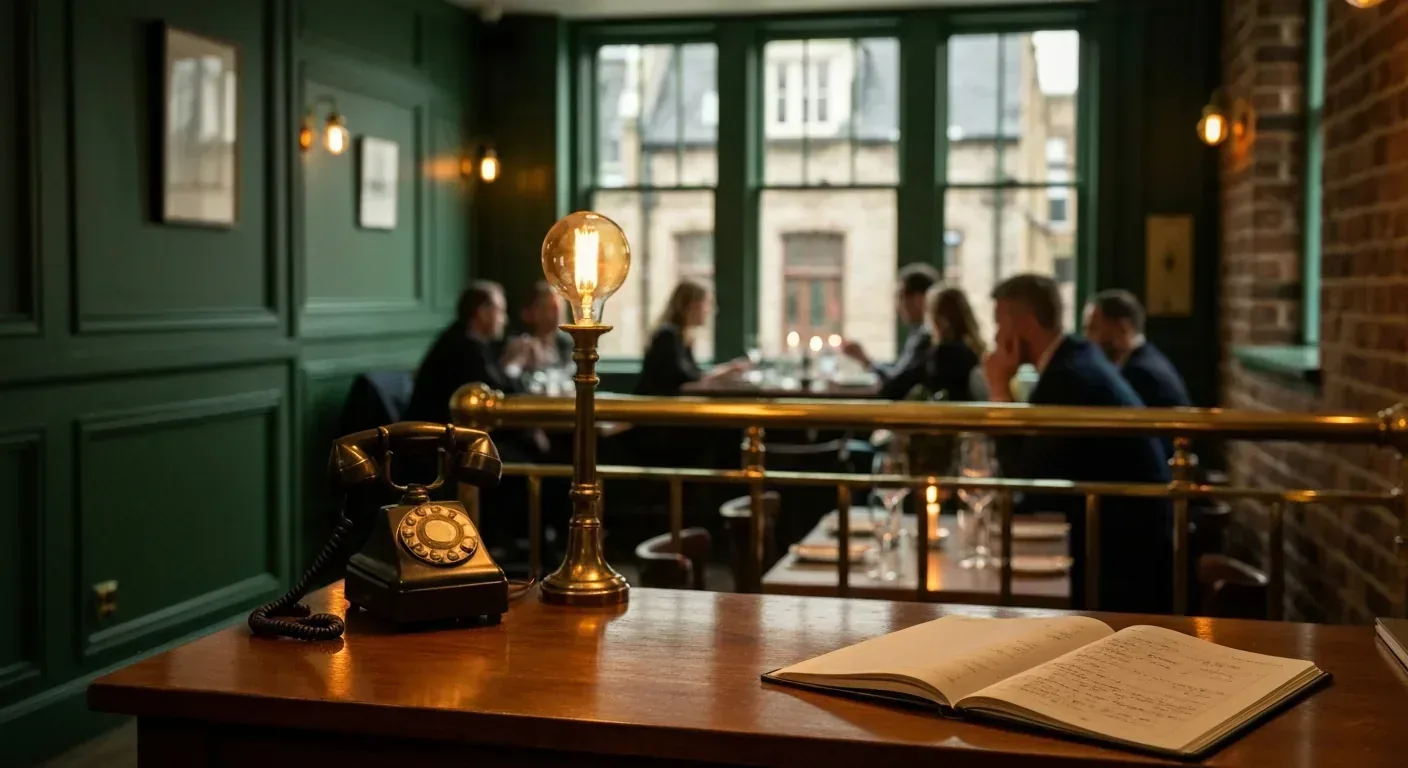
An AI voice agent for a UK restaurant in 2026 handles inbound bookings, allergen questions, group enquiries and after-hours calls — typically the 30–50% of peak-time calls that go unanswered when the maître d' is on the floor. A domain-trained operator like Eldris Voice is built on the restaurant's actual menu, allergen list, opening hours, table layout and special-event policies. It covers up to six languages, depending on plan, for the international tourist call mix that London, Edinburgh, Manchester and Bath restaurants face daily. Here is how it actually works in a working restaurant.
Why UK restaurants miss so many calls
UK restaurants miss 30–50% of inbound calls during peak service. The reason is structural. The phone is in front of the maître d' at 7pm; so are 30 walk-in guests, three tables with questions about wine, and a birthday party trying to find their booking.
The peak-time call abandonment picture:
- UKHospitality data consistently shows phone-handling capacity as a top-five operational pain point for independent operators.
- A central London independent of 60 covers typically receives 20–40 calls during a Friday 5–10pm service. The maître d' answers perhaps half.
- Ofcom's communications market data shows hospitality phone volume has not declined despite OpenTable — diners still ring for allergens, groups, and last-minute changes the booking system cannot handle.
Every missed call is either a lost booking (a competitor gets it) or a frustrated existing customer. The maître d' is not the problem. The infrastructure is.
What does an AI voice agent for a UK restaurant actually do?
A domain-trained AI voice agent answers the restaurant's phone 24/7, handles bookings against your live availability, answers allergen questions from your actual ingredient list, manages group enquiries, and escalates anything outside scope to the maître d'.
The capability set in a properly-built deployment:
- Bookings: Takes reservations against your live calendar (OpenTable, Resy, Quandoo, or direct PMS), confirms party size, time, special requests, books or waitlists.
- Allergens and dietary: Answers from a live allergen and ingredient list. "Does the lamb have garlic?" "Is the tasting menu nut-free?" — domain questions a generic FAQ-reader fails on.
- Group and private dining: Captures party-of-12 enquiries with date, requirements, dietary needs, budget, routes to the events team.
- Multilingual: Mandarin, French, Spanish, Italian and German tourist enquiries handled in-language. Eldris Voice covers one language pair on Starter, up to three languages on Growth and all six on Scale.
- After-hours: 11pm Tuesday cancellation, Sunday morning enquiry for next-Saturday dinner — handled at the same quality as a 1pm Friday call.
Bookings, allergens and after-hours is where 80% of the value sits.
Allergens — the call type that punishes generic AI
Restaurant allergen calls separate domain-trained agents from FAQ-readers. The stakes are real: misinforming a coeliac caller about gluten is a safety failure, not a marketing inconvenience.
A domain-trained operator handles allergen calls correctly because:
- It is built on your live ingredient and allergen matrix — every dish, every ingredient, every allergen flag, updated when the kitchen changes a recipe.
- It applies the UK Food Standards Agency 14-allergen rule consistently, never confusing a "gluten-free" caller with a "wheat-allergic" caller.
- It escalates appropriately when out of scope — cross-contamination protocols on a busy service night go to the kitchen, not a static script.
A commodity AI receptionist trained on an FAQ document gets some right and some wrong. The wrong ones can be expensive — for the diner's safety and the restaurant's reputation. This is why hospitality is a vertical where domain training is not optional. See multilingual AI receptionist for language plus allergen handling.

The London tourist call problem — multilingual at peak service
London receives roughly 20 million international visitors a year, and many call Soho, Mayfair, Covent Garden and Shoreditch restaurants in their own language. A French diner ringing Saturday at 7pm for Sunday lunch is a high-intent guest. If the response is "Sorry, no English?", the guest hangs up and books elsewhere.
Multilingual handling is not optional for a London restaurant in 2026. Hospitality-built operators typically handle:
- Mandarin — substantial inbound from the East Asian visitor mix and high-end Cantonese demand
- French — French and Belgian tourists; French-speaking diaspora
- Spanish — Spanish, Latin American, tourism-driven
- Italian — Italian tourists and community
- Portuguese — UK Portuguese community plus Brazilian visitors
Eldris Voice works in English, German, French, Spanish, Italian and Mandarin. Starter covers one language pair, Growth up to three languages and Scale all six. Portuguese can be requested on Scale and Enterprise. The operator detects the caller's language from the first second and conducts the booking in that language — not pre-recorded phrases, not a translation layer with lag, but native conversational handling.
This is the call type English-only commodity AI receptionists structurally cannot resolve. Domain training plus multilingual produces a step-change in capture rate during tourist-heavy peak service.
What does an AI voice agent for a UK restaurant cost?
Pricing for hospitality deployments in 2026:
| Tier | Provider | Monthly cost | Languages | Suitable for |
|---|---|---|---|---|
| Cheap FAQ-reader | CallAgentAI / MyAIFrontDesk | £36–£100 | English | Sole-trader cafés |
| No-code SaaS | Synthflow Pro | ~£296 | Multi (DIY) | Tech-comfortable owner-operators |
| Hybrid AI + human | Smith.ai | £240–£1,500 | English | US-style overflow |
| Domain-trained Growth | Eldris Voice | £997 | Up to 3 | Independents, allergens + tourists |
| Domain-trained Scale | Eldris Voice | £1,497 | 6 | Multi-site restaurant groups |
For an independent London restaurant of 60–120 covers, Eldris Voice Growth at £997/month is typically right — 24/7 bookings against OpenTable or Resy, allergens and up to three languages. For a 4+ site group, Scale or Enterprise (priced by quote) is appropriate. See pricing.
If an AI voice agent captures three additional Friday-evening bookings per week — at an average UK cover of £45–£75 — the platform is paid for several times over by month two.
Frequently asked questions
Can an AI voice agent take bookings for a UK restaurant?
Yes, a properly-built AI voice agent takes bookings 24/7 against your live calendar. Domain-trained operators like Eldris Voice integrate with OpenTable, Resy, Quandoo and most direct PMS, confirming party size, time, dietary needs, and special requests during the call. Cheap FAQ-readers take a message and pass it back to your reservation team — which is not booking; it is messaging.
Does an AI voice agent handle allergen questions safely?
A domain-trained AI voice agent handles allergen questions from a live ingredient matrix updated when the kitchen changes a recipe. It applies the UK Food Standards Agency 14-allergen rule and escalates out-of-scope questions to the kitchen. Commodity FAQ-readers are not safe for allergen calls because the document goes stale the moment a recipe changes.
How does an AI voice agent help during peak service?
An AI voice agent handles the 30–50% of peak-service calls that go unanswered while the maître d' is on the floor. Bookings, cancellations, allergen questions, groups and tourist calls all reach a consistent operator at 7pm Friday or 11pm Saturday. UKHospitality data consistently flags phone capacity as a top-five operational pain point.
Can an AI voice agent handle French, Mandarin or Italian tourist calls?
Yes. Eldris Voice works in six languages: English, German, French, Spanish, Italian and Mandarin. Starter covers one language pair, Growth up to three languages and Scale all six. London restaurants in tourist areas typically see 10–20% of calls in non-English; English-only agents lose every one. See multilingual AI receptionist.
How much does an AI voice agent for a UK restaurant cost?
UK restaurant AI voice agent pricing ranges from £36/month for cheap FAQ-readers to £1,497/month for domain-trained multilingual managed services. The £997/month Eldris Voice Growth tier covers most independent London restaurants of 60–120 covers with full bookings, allergens and up to three languages.
How long does it take to set up an AI voice agent for a restaurant?
A domain-trained agent typically takes ~14 days from contract to live calls. The build covers menu and allergen audit, integration with the booking platform (OpenTable, Resy, Quandoo or direct PMS), language scenario testing, and escalation flow setup.
Sources
The outside sources this article cites, in the order they appear.
- UKHospitality · ukhospitality.org.uk
- Ofcom's communications market data · ofcom.org.uk
- UK Food Standards Agency 14-allergen rule · food.gov.uk
Read Eldris Voice first in Google results:
Hear it for yourself
Call the live demo line.
The fastest way to judge an AI receptionist is to ring one. Ask about pricing, ask about languages, ask it to qualify you. You will be speaking to an AI receptionist. Eldris Voice costs from £497 a month plus a one-off setup fee.
Talk to a person: [email protected]